Showing posts with label OperatingSystem. Show all posts

Operating System - Process Scheduling

Definition

The process scheduling is the activity of the process manager that handles the removal of the running process from the CPU and the selection of another process on the basis of a particular strategy.
Process scheduling is an essential part of a Multiprogramming operating systems. Such operating systems allow more than one process to be loaded into the executable memory at a time and the loaded process shares the CPU using time multiplexing.

Process Scheduling Queues

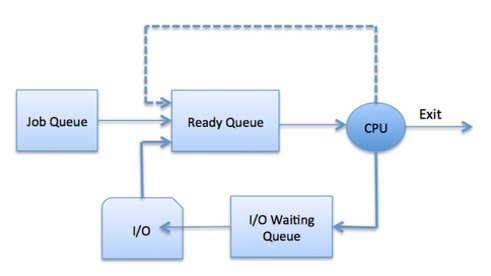
The OS maintains all PCBs in Process Scheduling Queues. The OS maintains a separate queue for each of the process states and PCBs of all processes in the same execution state are placed in the same queue. When the state of a process is changed, its PCB is unlinked from its current queue and moved to its new state queue.
The Operating System maintains the following important process scheduling queues −
  • Job queue − This queue keeps all the processes in the system.
  • Ready queue − This queue keeps a set of all processes residing in main memory, ready and waiting to execute. A new process is always put in this queue.
  • Device queues − The processes which are blocked due to unavailability of an I/O device constitute this queue.
Process Scheduling Queuing
The OS can use different policies to manage each queue (FIFO, Round Robin, Priority, etc.). The OS scheduler determines how to move processes between the ready and run queues which can only have one entry per processor core on the system; in the above diagram, it has been merged with the CPU.

Two-State Process Model

Two-state process model refers to running and non-running states which are described below −
S.N.State & Description
1
Running
When a new process is created, it enters into the system as in the running state.
2
Not Running
Processes that are not running are kept in queue, waiting for their turn to execute. Each entry in the queue is a pointer to a particular process. Queue is implemented by using linked list. Use of dispatcher is as follows. When a process is interrupted, that process is transferred in the waiting queue. If the process has completed or aborted, the process is discarded. In either case, the dispatcher then selects a process from the queue to execute.

Schedulers

Schedulers are special system software which handle process scheduling in various ways. Their main task is to select the jobs to be submitted into the system and to decide which process to run. Schedulers are of three types −
  • Long-Term Scheduler
  • Short-Term Scheduler
  • Medium-Term Scheduler

Long Term Scheduler

It is also called a job scheduler. A long-term scheduler determines which programs are admitted to the system for processing. It selects processes from the queue and loads them into memory for execution. Process loads into the memory for CPU scheduling.
The primary objective of the job scheduler is to provide a balanced mix of jobs, such as I/O bound and processor bound. It also controls the degree of multiprogramming. If the degree of multiprogramming is stable, then the average rate of process creation must be equal to the average departure rate of processes leaving the system.
On some systems, the long-term scheduler may not be available or minimal. Time-sharing operating systems have no long term scheduler. When a process changes the state from new to ready, then there is use of long-term scheduler.

Short Term Scheduler

It is also called as CPU scheduler. Its main objective is to increase system performance in accordance with the chosen set of criteria. It is the change of ready state to running state of the process. CPU scheduler selects a process among the processes that are ready to execute and allocates CPU to one of them.
Short-term schedulers, also known as dispatchers, make the decision of which process to execute next. Short-term schedulers are faster than long-term schedulers.

Medium Term Scheduler

Medium-term scheduling is a part of swapping. It removes the processes from the memory. It reduces the degree of multiprogramming. The medium-term scheduler is in-charge of handling the swapped out-processes.
A running process may become suspended if it makes an I/O request. A suspended processes cannot make any progress towards completion. In this condition, to remove the process from memory and make space for other processes, the suspended process is moved to the secondary storage. This process is called swapping, and the process is said to be swapped out or rolled out. Swapping may be necessary to improve the process mix.

Comparison among Scheduler

S.N.Long-Term SchedulerShort-Term SchedulerMedium-Term Scheduler
1It is a job schedulerIt is a CPU schedulerIt is a process swapping scheduler.
2Speed is lesser than short term schedulerSpeed is fastest among other twoSpeed is in between both short and long term scheduler.
3It controls the degree of multiprogrammingIt provides lesser control over degree of multiprogrammingIt reduces the degree of multiprogramming.
4It is almost absent or minimal in time sharing systemIt is also minimal in time sharing systemIt is a part of Time sharing systems.
5It selects processes from pool and loads them into memory for executionIt selects those processes which are ready to executeIt can re-introduce the process into memory and execution can be continued.

Context Switch

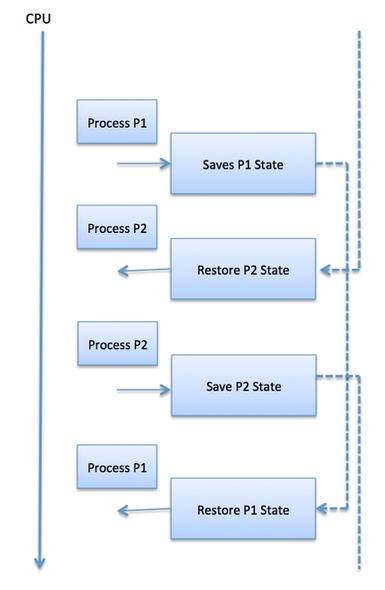
A context switch is the mechanism to store and restore the state or context of a CPU in Process Control block so that a process execution can be resumed from the same point at a later time. Using this technique, a context switcher enables multiple processes to share a single CPU. Context switching is an essential part of a multitasking operating system features.
When the scheduler switches the CPU from executing one process to execute another, the state from the current running process is stored into the process control block. After this, the state for the process to run next is loaded from its own PCB and used to set the PC, registers, etc. At that point, the second process can start executing.
Process Context Switch
Context switches are computationally intensive since register and memory state must be saved and restored. To avoid the amount of context switching time, some hardware systems employ two or more sets of processor registers. When the process is switched, the following information is stored for later use.
  • Program Counter
  • Scheduling information
  • Base and limit register value
  • Currently used register
  • Changed State
  • I/O State information
  • Accounting information

Operating System Scheduling algorithms

A Process Scheduler schedules different processes to be assigned to the CPU based on particular scheduling algorithms. There are six popular process scheduling algorithms which we are going to discuss in this chapter −
  • First-Come, First-Served (FCFS) Scheduling
  • Shortest-Job-Next (SJN) Scheduling
  • Priority Scheduling
  • Shortest Remaining Time
  • Round Robin(RR) Scheduling
  • Multiple-Level Queues Scheduling
These algorithms are either non-preemptive or preemptive. Non-preemptive algorithms are designed so that once a process enters the running state, it cannot be preempted until it completes its allotted time, whereas the preemptive scheduling is based on priority where a scheduler may preempt a low priority running process anytime when a high priority process enters into a ready state.

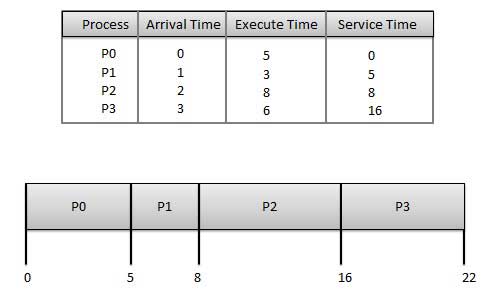
First Come First Serve (FCFS)

  • Jobs are executed on first come, first serve basis.
  • It is a non-preemptive scheduling algorithm.
  • Easy to understand and implement.
  • Its implementation is based on FIFO queue.
  • Poor in performance as average wait time is high.
First Come First Serve Scheduling Algorithm
Wait time of each process is as follows −
ProcessWait Time : Service Time - Arrival Time
P00 - 0 = 0
P15 - 1 = 4
P28 - 2 = 6
P316 - 3 = 13
Average Wait Time: (0+4+6+13) / 4 = 5.75

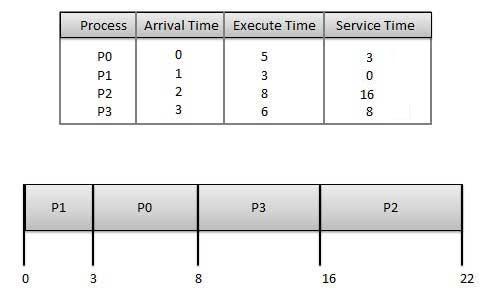
Shortest Job Next (SJN)

  • This is also known as shortest job first, or SJF
  • This is a non-preemptive scheduling algorithm.
  • Best approach to minimize waiting time.
  • Easy to implement in Batch systems where required CPU time is known in advance.
  • Impossible to implement in interactive systems where required CPU time is not known.
  • The processer should know in advance how much time process will take.
Shortest Job First Scheduling Algorithm
Wait time of each process is as follows −
ProcessWait Time : Service Time - Arrival Time
P03 - 0 = 3
P10 - 0 = 0
P216 - 2 = 14
P38 - 3 = 5
Average Wait Time: (3+0+14+5) / 4 = 5.50

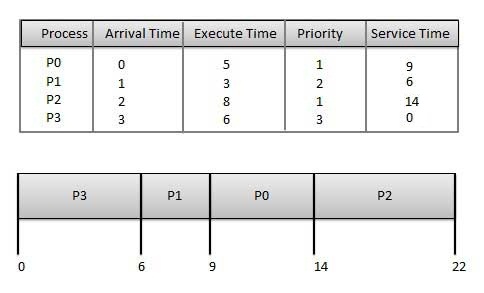
Priority Based Scheduling

  • Priority scheduling is a non-preemptive algorithm and one of the most common scheduling algorithms in batch systems.
  • Each process is assigned a priority. Process with highest priority is to be executed first and so on.
  • Processes with same priority are executed on first come first served basis.
  • Priority can be decided based on memory requirements, time requirements or any other resource requirement.
Priority Scheduling Algorithm
Wait time of each process is as follows −
ProcessWait Time : Service Time - Arrival Time
P09 - 0 = 9
P16 - 1 = 5
P214 - 2 = 12
P30 - 0 = 0
Average Wait Time: (9+5+12+0) / 4 = 6.5

Shortest Remaining Time

  • Shortest remaining time (SRT) is the preemptive version of the SJN algorithm.
  • The processor is allocated to the job closest to completion but it can be preempted by a newer ready job with shorter time to completion.
  • Impossible to implement in interactive systems where required CPU time is not known.
  • It is often used in batch environments where short jobs need to give preference.

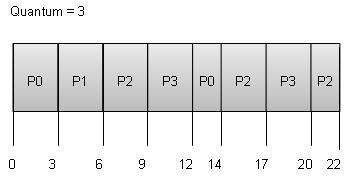
Round Robin Scheduling

  • Round Robin is the preemptive process scheduling algorithm.
  • Each process is provided a fix time to execute, it is called a quantum.
  • Once a process is executed for a given time period, it is preempted and other process executes for a given time period.
  • Context switching is used to save states of preempted processes.
Round Robin Scheduling Algorithm
Wait time of each process is as follows −
ProcessWait Time : Service Time - Arrival Time
P0(0 - 0) + (12 - 3) = 9
P1(3 - 1) = 2
P2(6 - 2) + (14 - 9) + (20 - 17) = 12
P3(9 - 3) + (17 - 12) = 11
Average Wait Time: (9+2+12+11) / 4 = 8.5

Multiple-Level Queues Scheduling

Multiple-level queues are not an independent scheduling algorithm. They make use of other existing algorithms to group and schedule jobs with common characteristics.
  • Multiple queues are maintained for processes with common characteristics.
  • Each queue can have its own scheduling algorithms.
  • Priorities are assigned to each queue.
For example, CPU-bound jobs can be scheduled in one queue and all I/O-bound jobs in another queue. The Process Scheduler then alternately selects jobs from each queue and assigns them to the CPU based on the algorithm assigned to the queue.

Operating System - Multi-Threading

What is Thread?

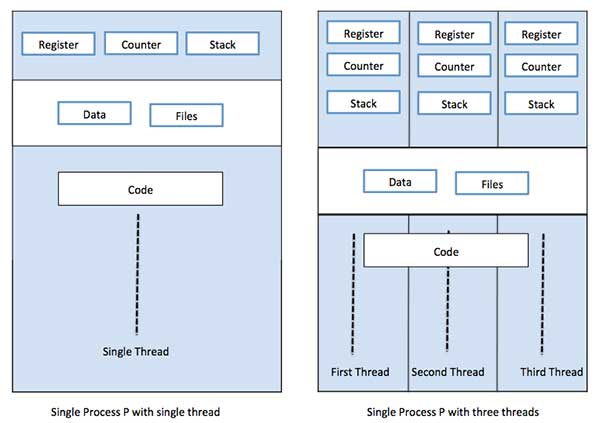
A thread is a flow of execution through the process code, with its own program counter that keeps track of which instruction to execute next, system registers which hold its current working variables, and a stack which contains the execution history.
A thread shares with its peer threads few information like code segment, data segment and open files. When one thread alters a code segment memory item, all other threads see that.
A thread is also called a lightweight process. Threads provide a way to improve application performance through parallelism. Threads represent a software approach to improving performance of operating system by reducing the overhead thread is equivalent to a classical process.
Each thread belongs to exactly one process and no thread can exist outside a process. Each thread represents a separate flow of control. Threads have been successfully used in implementing network servers and web server. They also provide a suitable foundation for parallel execution of applications on shared memory multiprocessors. The following figure shows the working of a single-threaded and a multithreaded process.
Single vs Multithreaded Process

Difference between Process and Thread

S.N.ProcessThread
1Process is heavy weight or resource intensive.Thread is light weight, taking lesser resources than a process.
2Process switching needs interaction with operating system.Thread switching does not need to interact with operating system.
3In multiple processing environments, each process executes the same code but has its own memory and file resources.All threads can share same set of open files, child processes.
4If one process is blocked, then no other process can execute until the first process is unblocked.While one thread is blocked and waiting, a second thread in the same task can run.
5Multiple processes without using threads use more resources.Multiple threaded processes use fewer resources.
6In multiple processes each process operates independently of the others.One thread can read, write or change another thread's data.

Advantages of Thread

  • Threads minimize the context switching time.
  • Use of threads provides concurrency within a process.
  • Efficient communication.
  • It is more economical to create and context switch threads.
  • Threads allow utilization of multiprocessor architectures to a greater scale and efficiency.

Types of Thread

Threads are implemented in following two ways −
  • User Level Threads − User managed threads.
  • Kernel Level Threads − Operating System managed threads acting on kernel, an operating system core.

User Level Threads

In this case, the thread management kernel is not aware of the existence of threads. The thread library contains code for creating and destroying threads, for passing message and data between threads, for scheduling thread execution and for saving and restoring thread contexts. The application starts with a single thread.
User level thread

Advantages

  • Thread switching does not require Kernel mode privileges.
  • User level thread can run on any operating system.
  • Scheduling can be application specific in the user level thread.
  • User level threads are fast to create and manage.

Disadvantages

  • In a typical operating system, most system calls are blocking.
  • Multithreaded application cannot take advantage of multiprocessing.

Kernel Level Threads

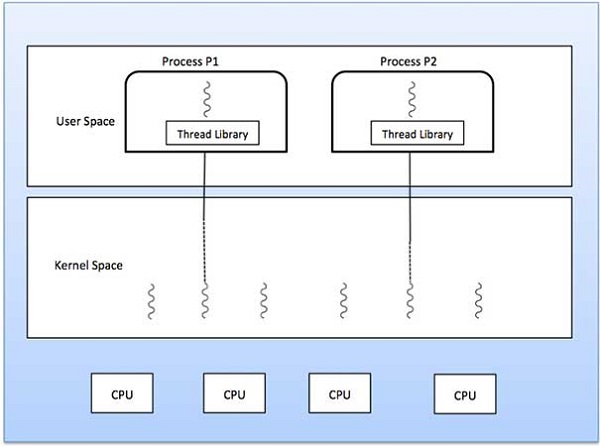
In this case, thread management is done by the Kernel. There is no thread management code in the application area. Kernel threads are supported directly by the operating system. Any application can be programmed to be multithreaded. All of the threads within an application are supported within a single process.
The Kernel maintains context information for the process as a whole and for individuals threads within the process. Scheduling by the Kernel is done on a thread basis. The Kernel performs thread creation, scheduling and management in Kernel space. Kernel threads are generally slower to create and manage than the user threads.

Advantages

  • Kernel can simultaneously schedule multiple threads from the same process on multiple processes.
  • If one thread in a process is blocked, the Kernel can schedule another thread of the same process.
  • Kernel routines themselves can be multithreaded.

Disadvantages

  • Kernel threads are generally slower to create and manage than the user threads.
  • Transfer of control from one thread to another within the same process requires a mode switch to the Kernel.

Multithreading Models

Some operating system provide a combined user level thread and Kernel level thread facility. Solaris is a good example of this combined approach. In a combined system, multiple threads within the same application can run in parallel on multiple processors and a blocking system call need not block the entire process. Multithreading models are three types
  • Many to many relationship.
  • Many to one relationship.
  • One to one relationship.

Many to Many Model

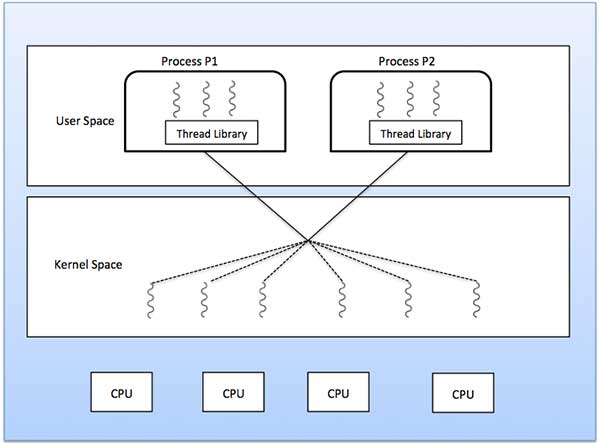
The many-to-many model multiplexes any number of user threads onto an equal or smaller number of kernel threads.
The following diagram shows the many-to-many threading model where 6 user level threads are multiplexing with 6 kernel level threads. In this model, developers can create as many user threads as necessary and the corresponding Kernel threads can run in parallel on a multiprocessor machine. This model provides the best accuracy on concurrency and when a thread performs a blocking system call, the kernel can schedule another thread for execution.
Many to many thread model

Many to One Model

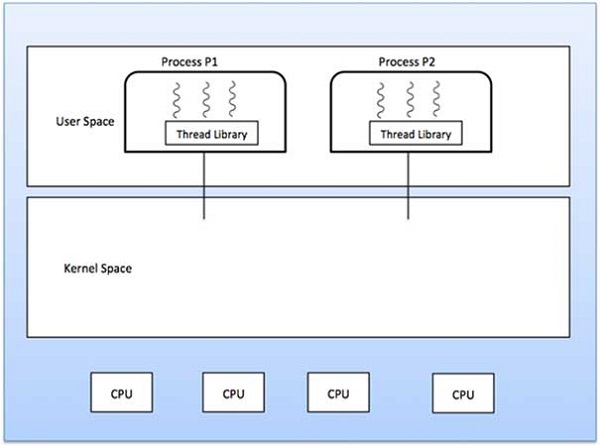
Many-to-one model maps many user level threads to one Kernel-level thread. Thread management is done in user space by the thread library. When thread makes a blocking system call, the entire process will be blocked. Only one thread can access the Kernel at a time, so multiple threads are unable to run in parallel on multiprocessors.
If the user-level thread libraries are implemented in the operating system in such a way that the system does not support them, then the Kernel threads use the many-to-one relationship modes.
Many to one thread model

One to One Model

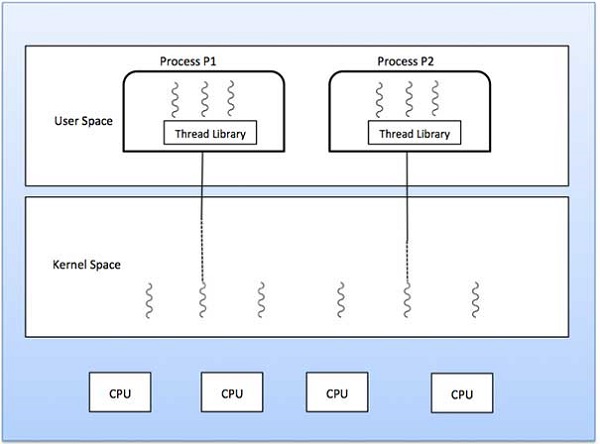
There is one-to-one relationship of user-level thread to the kernel-level thread. This model provides more concurrency than the many-to-one model. It also allows another thread to run when a thread makes a blocking system call. It supports multiple threads to execute in parallel on microprocessors.
Disadvantage of this model is that creating user thread requires the corresponding Kernel thread. OS/2, windows NT and windows 2000 use one to one relationship model.
One to one thread model

Difference between User-Level & Kernel-Level Thread

S.N.User-Level ThreadsKernel-Level Thread
1User-level threads are faster to create and manage.Kernel-level threads are slower to create and manage.
2Implementation is by a thread library at the user level.Operating system supports creation of Kernel threads.
3User-level thread is generic and can run on any operating system.Kernel-level thread is specific to the operating system.
4Multi-threaded applications cannot take advantage of multiprocessing.Kernel routines themselves can be multithreaded.